Heat & Consequences
Heat is the game's memory of your crimes, tracked per city section. It rises when crime happens on a block and decays when the block goes quiet. Heat is what pulls police toward you and feeds the Director's pressure.
NOTE
The map has two layers that both read this one heat value: a Heat layer that prints the numeric value on each section, and a Crime Rate layer that shades the same values as a color heatmap with a legend. They are two views of the same number, not two different metrics. Everything on this page is that one value.
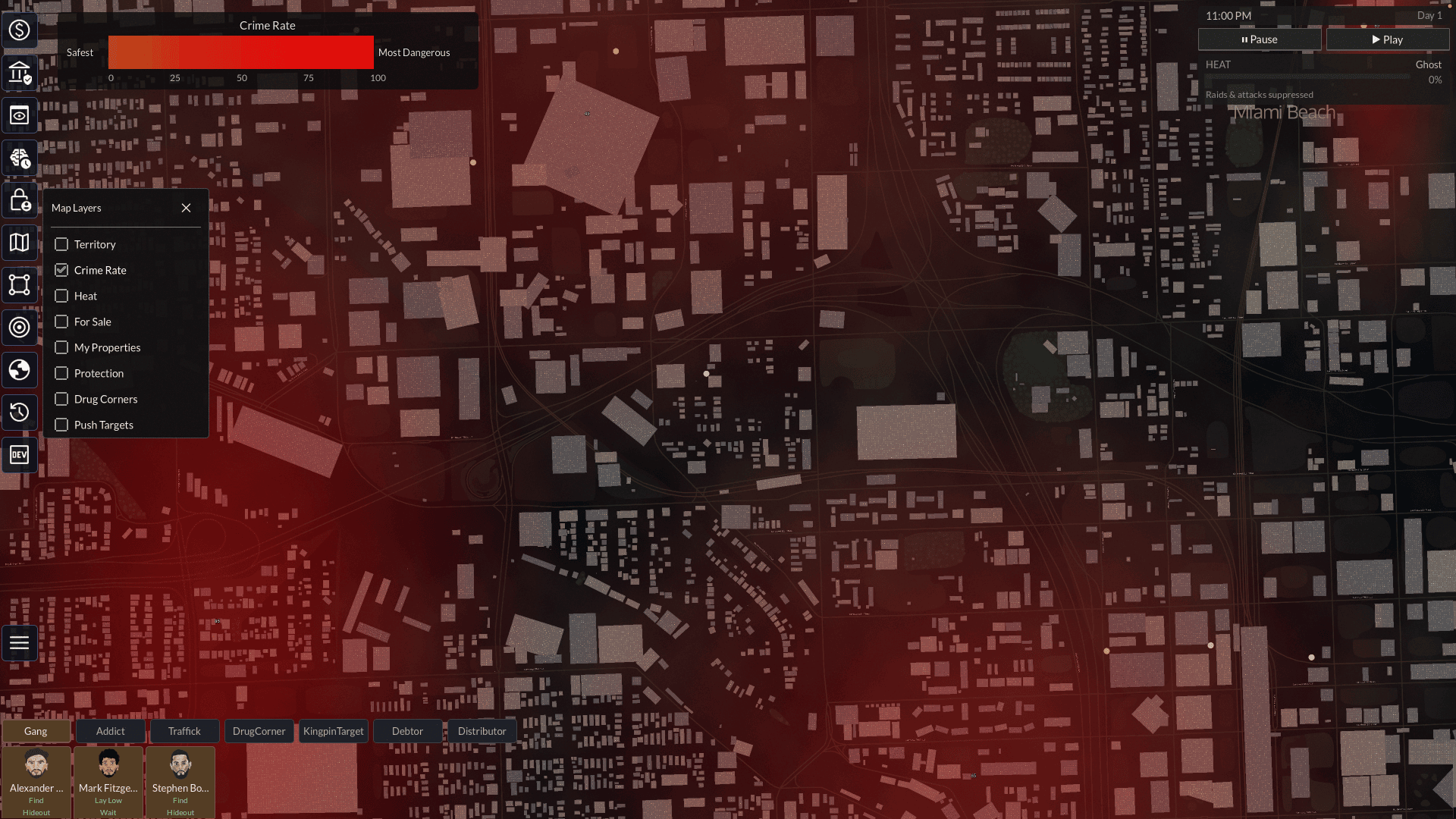
The heat overlay colors each section by its current heat, so you can read at a glance where police pressure is building and route work to cooler blocks.
The model
| Property | Value |
|---|---|
| Scope | Per section (city block / zone), not per pawn |
| Range | 0.0 to 100.0 |
| Raised by | Crime events completing in that section |
| Lowered by | Passive decay over time |
| Reported through | A single crime-report entry point, so every crime raises heat consistently |
Each section also has a static risk level (0 to 100) set at worldgen. Risk level is the block's baseline character and never changes. Heat is the dynamic value layered on top.
What raises heat
| Crime event | Heat gain |
|---|---|
| Drug deal completed | +8 |
| Bribe completed | +3 |
| Witness intimidated | +4 |
| Arrest made | +5 |
| Police investigation | +2 |
Heat is capped at 100. These gains are config values, so mods can retune them.
Initial seeding
Sections do not start cold. At game start each section seeds its heat from its risk level:
initial heat = risk level x 0.3
So a gang-turf section with risk level 50 starts at heat 15. There is already implied prior activity.
Decay
Heat decays every decay interval. The decay is exponential and scaled by the section's type, so rough areas stay hot longer than quiet ones:
heat = heat - (heat x decayRate) applied every decay interval, floored at 0
| Section type | Decay rate | Behavior |
|---|---|---|
| Residential | 0.05 | Bounces back fastest |
| Commercial | 0.04 | Fast |
| Warehouse | 0.03 | Medium |
| Industrial | 0.025 | Slow |
| Drug trade | 0.02 | Stays hot longest |
Exponential decay means high heat falls fastest in absolute terms but lingers as it approaches zero.
How heat changes police behavior
Police read the heat of the section they are in and shift their goal priorities accordingly:
| Police goal | Low heat (0-30) | Medium (31-65) | High (66-100) |
|---|---|---|---|
| Patrol beat | x1.5 | x1.0 | x0.5 |
| Investigate dealer | x0.5 | x1.0 | x2.0 |
| Maintain order | x1.0 | x1.2 | x1.5 |
The emergent result: quiet areas get routine patrols that keep them quiet; hot areas get reactive, aggressive policing. Police also arrest on weaker evidence in high-heat sections (the suspicion threshold drops), so the same behavior gets you busted faster on a hot block.
How heat changes crew behavior
Crew members weigh the heat of a deal location before committing. Whether they avoid a hot block depends on their own traits:
| Trait | Effect on risk tolerance |
|---|---|
| High Ruthlessness | Willing to work hotter blocks |
| High CurrentStress | Avoids hot blocks, wants to cool down |
A cautious, stressed member will route around a hot corner; a ruthless one will deal on it anyway.
Heat as a player tool
Heat is a strategic layer you manage, not just a punishment:
- Spread work across blocks so no single section stays hot.
- Pull activity off a block and let it decay before police saturate it.
- Build cover (fronts, safe houses) where it helps, accepting that cheap property is often in hot areas.
- Choose to bribe instead of fight when a block is already hot.
Relationship to the Director
Heat is local; the Director's threat score is global. Heat decides where police concentrate; the Director decides when bigger events (raids, rival attacks) fire. Sustained high heat across your turf makes both worse at once.
Modding
Heat gains, decay rates, thresholds, and the avoidance cutoff are all config values. See Modding: economy and tuning.