Combat
There is no manual shooting in BBox: Kingpin. When two hostiles meet, the simulation scores the situation for each of them and they decide for themselves whether to fight, flee, surrender, or make an arrest. Your job is the setup: who you send, on whose turf it happens, and who outnumbers whom. The AI plays out the fight.
NOTE
You do not hand-pick a pawn's weapon yet. A pawn fights with what it carries, and weapon quality is one factor in the scoring below. Player-controlled loadout is a planned extension, not a current feature.
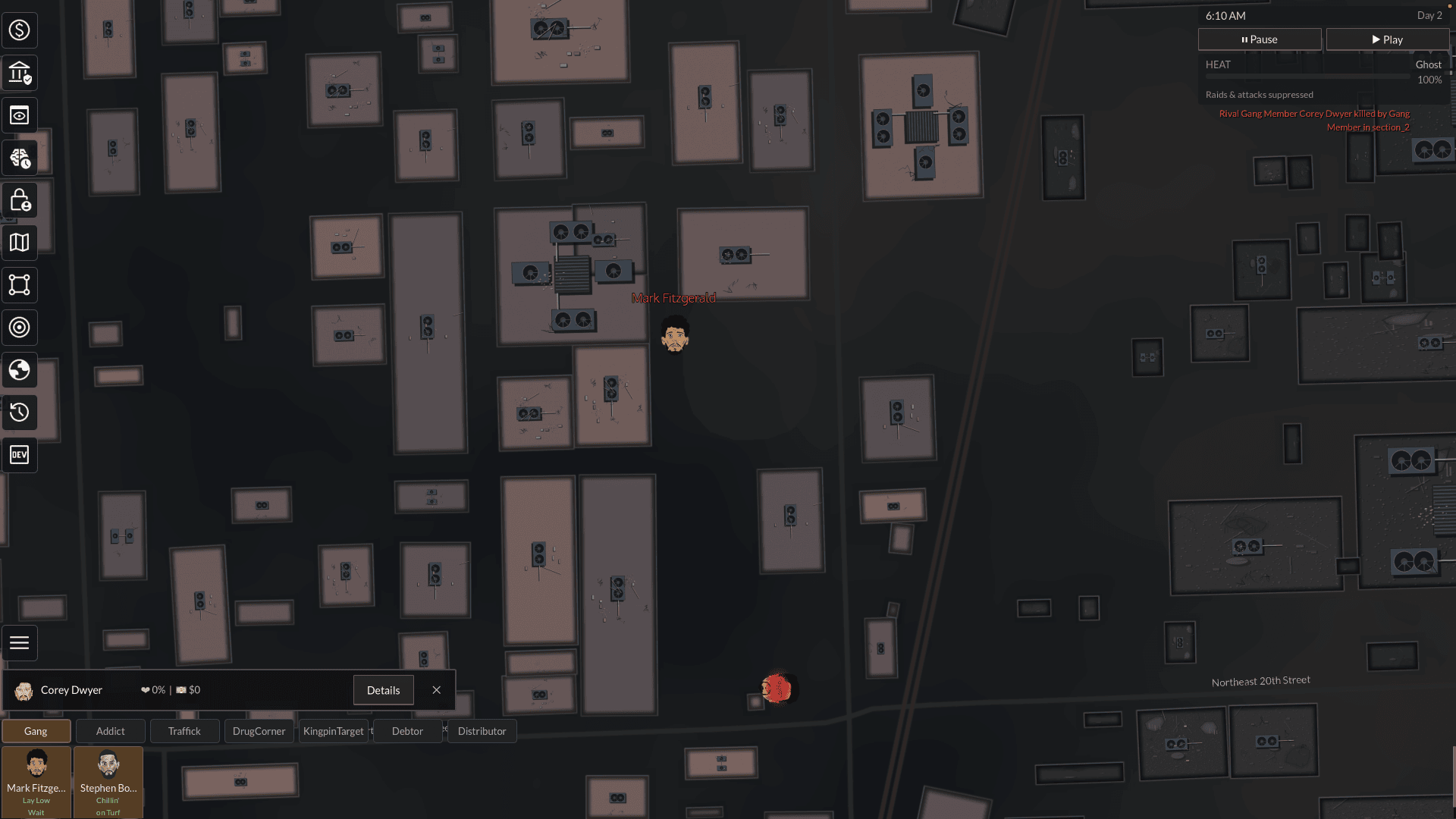
Combat resolves on its own: when hostiles meet, each one scores fight, flee, surrender, or arrest and acts. You set up who is there and where; the AI plays it out.
Who is hostile
Hostility is faction-based. Each faction declares which other factions it is hostile to. Two pawns are enemies if their factions are marked hostile to each other, not because of a hand-listed pair of types. This makes new factions (including modded ones) slot into combat automatically.
The decision, not a script
Combat choices are ordinary GOAP goals (FIGHT, FLEE, SURRENDER, ARREST_SUSPECT) gated by weight calculators. A sensor does the measuring and writes numeric engagement scores; GOAP makes the call.
| Step | What happens |
|---|---|
| 1 | A sensor scans for nearby hostiles. |
| 2 | For each threat, it scores Fight, Flee, Surrender, and Arrest. |
| 3 | Those scores are written to the pawn as properties. |
| 4 | Each combat goal's weight calculator reads its score; the highest effective priority wins. |
| 5 | With no threat nearby, all scores are 0, so combat goals stay at priority 0 and never fire. |
| Goal | Base priority | Driven by score | Available to |
|---|---|---|---|
| FIGHT | (high) | EngageFight | Crew, rivals, police |
| FLEE | 12.0 | EngageFlee | Crew, rivals |
| SURRENDER | 13.0 | EngageSurrender | Crew |
| ARREST_SUSPECT | 13.0 | EngageArrest | Police |
NOTE
A pawn only surrenders when it is actually being arrested. The surrender goal can score highest, but the give-up action requires a cop to be arresting the pawn, so a cornered pawn with no cop present fights or flees instead.
What goes into the score
The engagement score weighs the pawn's capability against the threat, the distance, and the balance of numbers. Capability is a weighted blend of traits and equipment:
| Factor | Example weight | Effect |
|---|---|---|
| Weapon quality | 0.30 | Better guns hit harder and raise Fight |
| Combat skill | 0.25 | Skilled fighters favor and win fights |
| Aggression | 0.15 | Aggressive pawns lean toward Fight over Flee |
| Strength | 0.10 | Raw physical capability |
These weights are config values per entity type, so mods can define a "glass cannon" or a "coward with a shotgun" by changing the blend. A high-skill, aggressive, well-armed pawn can realistically take on several weak enemies; a low-skill pawn reads the same situation as a reason to run.
Morale
A fight is not only the opening math. Morale shifts during the exchange and can turn a fight into a rout:
| Morale factor | Effect |
|---|---|
| Starting morale | Where the pawn begins |
| Ally killed | A penalty each time a friend goes down nearby |
| Outnumbered | A per-tick penalty once the enemy ratio passes a threshold |
| Rout threshold | When morale falls below this, the pawn breaks and flees |
The outnumbered penalty scales with how lopsided the fight is, so three-on-one grinds morale down faster than two-on-one. This is why bringing numbers matters more than any single strong pawn.
Arrests
Arrest is a cooperative chain between a cop and a target, not a single action:
| Stage (police) | Meaning |
|---|---|
| Approach | Close on the chosen suspect |
| Apprehend | Confirm in range |
| Cuff | Wait for the suspect to give up, then complete the arrest |
To avoid flickering between "fight" and "arrest" when scores are close, a cop that has committed to an arrest locks onto that target and stays on it until the target is cuffed, escapes for good, or the cop is taken out. Likewise, once a pawn is marked as being arrested, that state sticks until the arrest resolves, so a pawn cannot wriggle back into a fight mid-arrest. A pawn that has surrendered or been arrested is skipped by the combat sensor entirely, so it will not suddenly re-enter combat.
Arrests are not a game over. They are a decision: let the member serve, pay to bail them out, keep a contact on retainer to hear about it early, or use the prison itself to remove a rival quietly. These player options are covered under the Economy and Betrayal systems.
Trait feedback
Combat feeds back into traits. Fighting raises Aggression, Stress, and trauma over time and can lower Empathy. Surrender is psychologically costly. Surviving raids builds (or breaks) Courage. Over many fights a pawn's personality visibly hardens, which then changes how they read the next fight.
Modding
Combat is config-driven: capability weights, base damage, morale thresholds, and the outnumbered penalty all live in an engagement config, and hostility lives in a faction matrix. See Modding: economy and tuning and Entities & Identities.